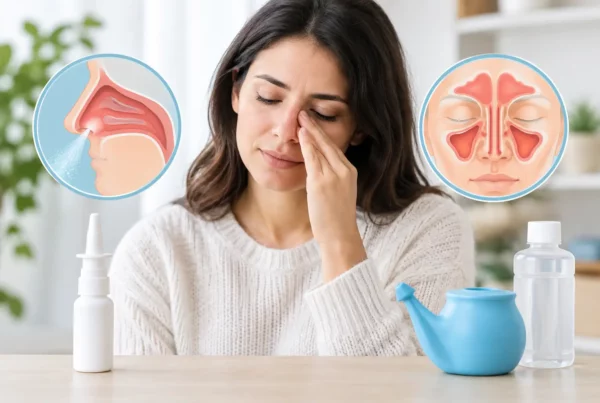
A blocked nose after a cold can make your face feel heavy, your sleep poor and everyday tasks surprisingly difficult. But is it cold congestion or sinus infection? The symptoms overlap, and it is not always possible to tell at home. What matters most is the overall pattern: how long symptoms have lasted, whether they are improving, and whether any warning signs are present.
Most sinus symptoms following a cold settle without antibiotics. However, severe, persistent or worsening symptoms deserve advice from a doctor or qualified healthcare professional.
Why colds and sinus symptoms feel so similar
A cold is usually caused by a virus. It can cause a runny or blocked nose, sneezing, sore throat, cough, tiredness and a reduced sense of smell. The lining inside the nose can become swollen, narrowing the small openings that connect the nose and sinuses.
The sinuses are air-filled spaces in the bones around the nose, cheeks, forehead and eyes. When the nasal lining is swollen and mucus does not move as freely, you may notice pressure or discomfort in the face, a blocked nose, thick nasal discharge or mucus running down the back of the throat. This is often called acute rhinosinusitis, or more simply, sinusitis.
A cold can therefore lead to sinus symptoms without meaning there is a bacterial infection. Facial pressure alone does not confirm sinusitis either. Headache, tooth pain, migraine and other conditions can feel similar, particularly when symptoms are recurring or one-sided.
Cold congestion or sinus infection: look at the pattern
The colour or thickness of mucus is not enough to diagnose an infection. Yellow or green mucus can occur during an ordinary viral cold as the immune system responds. Instead, consider the timing and trajectory of your symptoms.
With a typical cold, symptoms often peak over the first few days and then gradually ease. Nasal congestion and cough can linger, but there should usually be a sense of steady improvement. Acute sinusitis symptoms may last longer. According to UK clinical guidance, symptoms commonly persist for around two to three weeks, although many cases still improve without antibiotic treatment.
It may be sensible to seek advice if symptoms have lasted for about 10 days without improving, become clearly worse after initially getting better, or remain troublesome for several weeks. A clinician can consider the whole picture, including your medical history, examination findings and whether another cause is more likely.
Symptoms that can occur with sinusitis include:
- nasal blockage or congestion
- discharge from the nose, or mucus at the back of the throat
- pressure, tenderness or discomfort around the cheeks, eyes or forehead
- reduced sense of smell
- cough, particularly at night
- upper tooth discomfort, tiredness or a feeling of fullness in the ears
Not everyone experiences the same combination. Fever can occur with a cold or sinusitis, but its presence does not by itself show that antibiotics are needed.
Practical self-care while symptoms are mild
If your symptoms are mild to moderate and you are otherwise well, a few straightforward measures may make you more comfortable while your body recovers. Rest, drink enough fluid for your needs and avoid smoking, which can irritate the nose and airways.
Saline nasal sprays or rinses may be considered to moisten the nasal passages and help clear nasal secretions. Use products as directed, and follow hygiene instructions carefully. If you make up a rinse yourself, use water that has been boiled and cooled, or otherwise prepared according to the device instructions. Do not share nasal devices.
For pain, pressure or fever, paracetamol/acetaminophen or ibuprofen may be suitable for some adults when used according to the pack instructions. They are not suitable for everyone. For example, ibuprofen may not be appropriate for people with certain stomach, kidney, heart or asthma conditions, or during pregnancy. A pharmacist can help you choose safely.
Short-term decongestant sprays or tablets may reduce the feeling of blockage for some people, but they have limitations. Nasal decongestant sprays should generally not be used for more than a few days because overuse can make congestion harder to manage. Decongestants may also be unsuitable if you have high blood pressure, heart disease, glaucoma, an overactive thyroid, prostate problems, or take certain medicines. Ask a pharmacist before using them if you are unsure.
Steam inhalation is often suggested for congestion, but evidence that it improves sinus symptoms is limited and hot water can cause burns. Essential oils should not be put inside the nose. A comfortably warm shower or a humidified room may feel soothing for some people, but neither is a substitute for medical assessment when symptoms are concerning.
When antibiotics may, or may not, be appropriate
Antibiotics do not work against viruses, and many episodes of acute sinusitis improve on their own. Using antibiotics when they are unlikely to help can cause side effects and contributes to antibiotic resistance.
That does not mean antibiotics are never needed. A doctor or qualified healthcare professional may consider them when symptoms and examination suggest a bacterial infection, when a person is at higher risk of complications, or when illness is severe or prolonged. The right decision depends on the individual, not just a single symptom such as coloured mucus.
If you are prescribed an antibiotic, take it exactly as directed and seek advice if you develop a suspected side effect. Do not use leftover antibiotics or antibiotics prescribed for someone else.
Symptoms that need prompt medical advice
Arrange medical advice promptly if you have severe facial pain, a high temperature that is not settling, symptoms that are worsening, or symptoms that persist without improvement. This is especially relevant if you have a weakened immune system, are receiving treatment that affects immunity, or have a significant long-term health condition.
Seek urgent medical assessment for swelling, redness or pain around an eye; changes in vision; severe headache; confusion; a stiff neck; persistent vomiting; or marked drowsiness. These symptoms are uncommon, but they need prompt attention. Call 999 or attend an emergency department if symptoms are severe or you think someone may be seriously unwell.
Recurrent episodes, symptoms affecting only one side of the face or nose, repeated nosebleeds, or ongoing loss of smell also warrant discussion with a doctor or qualified healthcare professional. These patterns may need a different assessment than a straightforward post-cold illness.
Choosing a nasal product carefully
Nasal products do not all have the same intended purpose, ingredients or instructions. Before choosing one, consider your main symptom, other medicines you take and any relevant health conditions. A pharmacist can help compare appropriate over-the-counter options.
If considering a sinus-focused nasal spray such as Nasodren®, read and follow the product label, package leaflet or instructions for use. Check who should not use it, possible side effects and when to stop self-care and seek professional advice. A nasal product should not be used as a substitute for diagnosis or clinician-led treatment when that is needed.
Give recovery time, but keep checking the direction
The most useful question is often not, “Are my symptoms gone yet?” but, “Am I gradually getting better?” Congestion can be slow to lift after a cold, especially when sleep has been disrupted or the air is dry. Gentle self-care and realistic expectations can help.
If the direction changes – symptoms become more intense, new warning signs appear, or there is no meaningful improvement – speak to a doctor, pharmacist or qualified healthcare professional rather than simply adding more products.
This content is for general information only and does not replace advice from a qualified healthcare professional. Always read and follow the product label, package leaflet or instructions for use. Seek medical advice if symptoms are severe, persistent, worsening, recurrent or concerning.
Sources
NICE. Sinusitis (acute): antimicrobial prescribing, NG79.
NHS. Sinusitis (sinus infection).
NICE Clinical Knowledge Summaries. Sinusitis – acute.
A little patience is often part of recovering from a cold, but monitoring your symptoms and asking for help when the pattern is not reassuring is a sensible form of self-care.