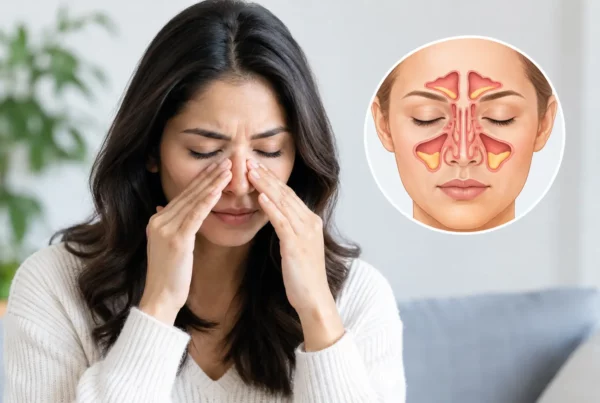
Sinusitis lasts between 2 and 3 weeks in most acute cases. The exact duration depends on the type of sinusitis: acute sinusitis resolves within 4 weeks according to NHS.uk; subacute sinusitis persists 4–12 weeks; chronic sinusitis (chronic rhinosinusitis, CRS) lasts 12 weeks or more despite treatment; recurrent acute sinusitis involves 4 or more separate episodes per year, each lasting at least 7–10 days with complete resolution between episodes.
Sinusitis accounts for approximately 30 million primary care visits annually in the United States alone, according to StatPearls (Kwon, Hathaway and Sutton, 2025). In the UK, NHS Inform (Scotland) states sinusitis usually gets better within 2 or 3 weeks, and Patient.info confirms acute sinusitis spans 4–30 days. The sinusitis duration varies by type, cause, treatment and individual immune status. Nasodren® (Cyclamen europaeum extract nasal spray, 50mg) is the only natural treatment in EPOS2012 European sinusitis guidelines, with 90% of patients restoring normal sinus function within 7 days.
How Long Does Sinusitis Last? Duration by Type
Sinusitis typically lasts 2–3 weeks in acute cases. Subacute sinusitis persists 4–12 weeks. Chronic sinusitis (chronic rhinosinusitis) lasts 12 weeks or more. NHS.uk states acute sinusitis usually clears within 4 weeks without treatment.
The following table compares the 4 sinusitis types across duration, primary cause, NHS guidance and treatment.
| Type | Duration | Primary Cause | NHS Guidance (UK) | Treatment |
|---|---|---|---|---|
| Acute | <4 weeks (usually 2–3 weeks) | Viral (90–98%) | Self-care; see GP if no improvement >10 days | Rest, fluids, saline rinse, Nasodren® |
| Subacute | 4–12 weeks | Viral or bacterial | GP review recommended | Nasal steroid spray; antibiotic if bacterial confirmed |
| Chronic (CRS) | ≥12 weeks | Multifactorial | ENT referral recommended | Intranasal corticosteroids; FESS if refractory |
| Recurrent acute | 4+ episodes/year | Structural or allergic cause | ENT review; investigate underlying cause | Treat underlying cause; preventive steroid spray |
The 10-day rule is the key clinical dividing line. Sinusitis symptoms persisting beyond 10 days without improvement, or worsening after an initial 5-day improvement, indicate possible bacterial superinfection or post-viral rhinosinusitis (PVRS) and warrant GP or pharmacist review.
How Long Does Acute Sinusitis Last?
Acute sinusitis lasts less than 4 weeks. Most cases resolve within 2–3 weeks without treatment. NHS Inform (Scotland) states sinusitis usually gets better within 2 or 3 weeks. NHS.uk confirms acute sinusitis usually clears up on its own within 4 weeks.
Patient.info (UK) defines acute sinusitis as lasting 4–30 days, adding that many cases last 1 week and that 2–3 weeks is not unusual. StatPearls (Kwon et al., 2025) reports approximately 30 million acute rhinosinusitis diagnoses annually in the US. The American Academy of Allergy, Asthma and Immunology (AAAAI) reports 70% of sinus infections resolve within 2 weeks without any antibiotics.
The 10-day rule applies to acute sinusitis: symptoms persisting beyond 10 days without improvement, or symptoms that improve initially then worsen after day 5 (double-worsening pattern), indicate possible bacterial acute rhinosinusitis (ABRS). Bacterial superinfection develops in 0.5–2% of viral acute sinusitis cases in adults and 5–10% in children.
Nasodren® shortens acute sinusitis duration to 7 days in 90% of patients — compared with 2–3 weeks with watchful waiting. Nasodren® holds a Level A recommendation in EPOS2012 European rhinosinusitis guidelines and is evaluated in over 30 randomised controlled trials.
Day-by-Day Recovery Timeline for Acute Sinusitis
Acute sinusitis recovery follows 7 identifiable day-group stages.
- Days 1–3 (Onset): Nasal congestion worsens, thick mucus accumulates, facial pressure builds. Sinusitis often follows a cold that appeared to be improving. Fever is possible in bacterial cases.
- Days 3–5 (Peak): Nasal blockage reaches maximum severity. Facial pain and pressure are most pronounced. Loss of smell may occur. Disturbed sleep from congestion and post-nasal drip is common.
- Days 5–7 (Viral plateau): Viral acute rhinosinusitis stops worsening. Mucus begins to thin. Facial pressure eases. Nasodren® shows its most visible drainage effect at this stage, actively clearing accumulated mucus through trigeminal nerve stimulation.
- Days 7–10 (Recovery gradient): Progressive improvement occurs: congestion reduces, sense of smell returns. Many acute sinusitis cases resolve fully at this stage without any prescription treatment.
- Day 10+ (10-day rule checkpoint): No improvement by day 10 triggers the 10-day rule. GP or pharmacist review is warranted. Bacterial superinfection occurs in 0.5–2% of cases. Post-viral rhinosinusitis (PVRS) is the more likely cause.
- Weeks 2–3 (Full viral resolution): Most untreated viral acute sinusitis cases resolve fully within 2–3 weeks (NHS Inform, Patient.info). 70% of sinus infections clear within 2 weeks without antibiotics (AAAAI).
- Weeks 3–4 (Subacute threshold): Symptoms persisting beyond 4 weeks enter the subacute sinusitis category. GP review is required at this point to prevent progression to chronic rhinosinusitis.
This timeline applies to viral acute rhinosinusitis, which accounts for 90–98% of cases. Bacterial acute rhinosinusitis follows a different trajectory and requires antibiotic treatment when confirmed.
How Long Does Bacterial Sinusitis Last?
Bacterial sinusitis lasts 10–14 days with antibiotic treatment. Without antibiotics, 80–90% of bacterial sinusitis still resolves within 14 days, according to a meta-analysis by Falagas, Giannopoulou, Vardakas et al. published in The Lancet Infectious Diseases in 2008.
Bacterial acute rhinosinusitis (ABRS) is suspected when 3 clinical indicators are present: symptoms persisting beyond 10 days without improvement; the double-worsening pattern (initial improvement followed by return and worsening of symptoms); or severe unilateral facial pain with fever above 38°C (100.4°F). ABRS is caused by 3 primary pathogens: Streptococcus pneumoniae, Haemophilus influenzae and Moraxella catarrhalis.
NHS.uk states antibiotics are “not common” for sinusitis because sinusitis is usually caused by a virus, not bacteria. NICE guidance for the UK advises watchful waiting as first-line treatment, with a back-up antibiotic prescription offered to patients who do not improve within 10 days. When antibiotics are prescribed for ABRS, amoxicillin-clavulanate is first-line and the course runs 10–14 days.
Bacterial sinusitis causes 0.5–2% of acute sinusitis cases in adults and 5–10% in children. The majority of sinusitis cases presenting with yellow or green nasal discharge are viral, not bacterial. Discharge colour alone is not a diagnostic indicator for bacterial infection and does not indicate antibiotic necessity.
How Long Does Viral Sinusitis Last?
Viral sinusitis lasts 7–14 days in most cases and resolves without antibiotic treatment. Viral upper respiratory infection causes 90–98% of acute rhinosinusitis (EPOS2012, AAO-HNS, AAFP). Antibiotics do not treat viral sinusitis and do not shorten its duration.
NHS.uk confirms sinusitis is usually caused by a virus, not bacteria, and that antibiotics are not commonly needed. NHS Inform states sinusitis usually gets better within 2 or 3 weeks without treatment. The American Academy of Allergy, Asthma and Immunology (AAAAI) states 70% of sinus infections resolve within 2 weeks without medication.
Post-viral rhinosinusitis (PVRS) is the most common form of acute rhinosinusitis. PVRS occurs when symptoms persist beyond 10 days after a viral upper respiratory tract infection, without bacterial superinfection developing. PVRS is still viral in origin and does not indicate antibiotics. The 4-step PVRS mechanism is: (1) viral rhinitis causes nasal mucosal oedema; (2) oedema blocks the sinus ostia in the ostiomeatal complex; (3) sinus drainage fails and mucus accumulates; (4) symptoms persist beyond the initial viral illness.
Nasodren® (Cyclamen europaeum extract) targets viral sinusitis and PVRS directly: Cyclamen saponins stimulate trigeminal nerve receptors, opening blocked sinus ostia and actively draining accumulated mucus. Nasodren® is preservative-free, produces no rebound congestion and achieves resolution in 90% of patients within 7 days. Nasal decongestants (oxymetazoline, xylometazoline) are limited to a maximum of 5–7 days use by Patient.info and 1 week by NHS.uk due to rhinitis medicamentosa risk.
How Long Does Chronic Sinusitis Last?
Chronic sinusitis (chronic rhinosinusitis, CRS) lasts 12 weeks or more by definition. CRS does not resolve on its own without targeted specialist treatment. StatPearls Chronic Rhinosinusitis (NCBI, updated 2026) defines CRS as persistent sinonasal symptoms with mucosal inflammation lasting 12 weeks or more.
WebMD reports that some research shows CRS symptoms can linger for more than a decade. The ENT Consultancy (UK, 2025) states: “When symptoms persist beyond 12 weeks, it is no longer a simple infection but chronic rhinosinusitis” — a condition involving ongoing inflammation of the sinus tissues that does not resolve without targeted treatment. Welbeck Health (UK private ENT) confirms chronic sinusitis can last 12 weeks or longer and may need specialist treatment to prevent flare-ups. CRS affects approximately 10–14% of adults in the UK.
2 CRS subtypes determine treatment pathway and expected duration. CRSwNP (chronic rhinosinusitis with nasal polyps) involves eosinophilic type 2 inflammation associated with asthma and NSAID sensitivity; CRSwNP is more likely to persist and responds to intranasal corticosteroids and biologics including dupilumab and omalizumab. CRSsNP (without nasal polyps) is often driven by bacterial biofilm formation and anatomical obstruction; CRSsNP responds to long-term intranasal corticosteroids and saline irrigation.
CRS does not resolve with short antibiotic courses. NHS treatment for CRS follows a stepped pathway: intranasal corticosteroid spray (fluticasone, mometasone) prescribed for several months; ENT referral if symptoms persist; functional endoscopic sinus surgery (FESS) for CRS refractory to medical treatment.
How Long Does Subacute Sinusitis Last?
Subacute sinusitis lasts between 4 and 12 weeks. Subacute sinusitis occupies the clinical continuum between acute rhinosinusitis and chronic rhinosinusitis. Patient.info (UK) defines subacute sinusitis as lasting 4–12 weeks. Symptoms are often less severe than in acute sinusitis but persistent.
Subacute sinusitis develops from 3 common origins: incomplete resolution of acute sinusitis without adequate treatment; an unidentified structural obstruction such as a deviated nasal septum or nasal polyps; or uncontrolled allergic rhinitis preventing mucosal recovery. WebMD notes that subacute sinusitis symptoms may not be as severe as in acute sinusitis.
GP review is strongly warranted at the 4-week mark without improvement to prevent progression to CRS. Treatment for subacute sinusitis includes a nasal steroid spray prescribed by GP or pharmacist, investigation for underlying allergic rhinitis, antibiotic prescription only if bacterial infection is confirmed, and daily saline irrigation. CT imaging is not routinely recommended at the subacute stage unless symptoms are severe or structural cause is suspected.
How Long Does Recurrent Sinusitis Last?
Recurrent acute sinusitis is diagnosed when 4 or more acute sinusitis episodes occur within a single year, each lasting at least 7–10 days, with complete symptom resolution between episodes. Patient.info (UK) states most people only have one or two bouts of acute sinusitis in their lives; some people have repeated bouts.
Each individual episode of recurrent sinusitis follows the same acute sinusitis duration and resolves within 4 weeks. The distinguishing feature from chronic rhinosinusitis (CRS) is complete symptom-free intervals between episodes. In CRS, symptoms are continuous. Risk factors for recurrent acute sinusitis include nasal polyps, deviated nasal septum, allergic rhinitis, cigarette smoking and immune deficiency.
GP referral to ENT is appropriate when 3 or more episodes occur per year, when episodes significantly impair quality of life, or when a structural cause is suspected. ENT assessment includes nasal endoscopy and CT scan. FESS is considered when structural abnormality is confirmed as the cause. Between episodes, preventive treatment with intranasal corticosteroids and allergen avoidance reduces recurrence frequency.
How Long Does Sinusitis Last Without Antibiotics?
Most sinusitis (90–98%) is viral and resolves within 2–3 weeks without antibiotics. Antibiotics do not shorten the duration of viral sinusitis because antibiotics act only on bacteria.
The American Academy of Allergy, Asthma and Immunology (AAAAI) reports 70% of sinus infections resolve within 2 weeks without any antibiotics. A meta-analysis of randomised controlled trials by Falagas, Giannopoulou and Vardakas, published in The Lancet Infectious Diseases in September 2008, found that 80–90% of bacterial sinusitis also resolves without antibiotics within 14 days. NHS.uk states antibiotics are not commonly needed because sinusitis is usually caused by a virus, not bacteria. NICE guidance for the UK recommends watchful waiting as first-line treatment for acute sinusitis, with a backup antibiotic prescription offered only when symptoms fail to improve after 10 days.
3 reasons explain antibiotic overuse in sinusitis. Yellow or green nasal discharge is not diagnostic of bacterial infection and does not indicate antibiotics are needed. The double-worsening pattern is the most reliable clinical indicator of bacterial sinusitis, not discharge colour. The Cochrane review on antibiotics for acute rhinosinusitis found minimal benefit over placebo for most cases.
Nasodren® offers an evidence-based alternative to antibiotics for acute sinusitis: 90% of patients resolve within 7 days, without antibiotics, resistance risk or rebound congestion. Nasodren® holds a Level A recommendation in EPOS2012 guidelines and has been evaluated in over 30 published randomised controlled trials.
What Affects How Long Sinusitis Lasts?
7 primary factors determine how long a sinusitis episode lasts.
- Type of sinusitis: Viral ARS resolves in 7–14 days. PVRS lasts up to 3 weeks. Bacterial ARS takes 10–14 days with treatment. Subacute sinusitis persists 4–12 weeks. CRS lasts 12 weeks or more.
- Underlying structural cause: Deviated nasal septum and nasal polyps prevent normal sinus drainage; sinusitis persists until the obstruction is addressed. Allergic rhinitis driving recurrent sinusitis prolongs episodes until allergy is controlled.
- Treatment initiated: No treatment (watchful waiting) results in viral resolution in 7–21 days. Nasodren® initiated on day 1 achieves resolution in 90% of patients within 7 days. Intranasal corticosteroids reduce inflammation and shorten subacute and CRS episodes. Antibiotics (for confirmed ABRS) require a 10–14-day course.
- Immune system status: Immunocompromised patients, including those with diabetes mellitus, HIV, corticosteroid therapy or chemotherapy, have impaired mucociliary clearance and prolonged sinusitis duration. Cystic fibrosis and primary ciliary dyskinesia cause permanent mucociliary impairment.
- Cigarette smoke exposure: Active and passive cigarette smoking impairs mucociliary function. Mucus clears more slowly and sinusitis episodes last longer and recur more frequently in smokers than in non-smokers.
- Nasal decongestant overuse: Oxymetazoline or xylometazoline decongestant nasal spray used beyond 5–7 days (Patient.info) or 1 week (NHS.uk) causes rhinitis medicamentosa (rebound congestion) — paradoxically prolonging nasal symptoms beyond the original sinusitis duration.
- Nasal polyps: Nasal polyps physically obstruct sinus drainage pathways. CRSwNP (chronic rhinosinusitis with nasal polyps) lasts longer and is more refractory to standard treatment than CRSsNP.
When Should You See a GP About Sinusitis? NHS Guidance
The NHS recommends seeing a GP when sinusitis symptoms last more than 10 days without improvement, worsen significantly, or include red-flag features.
NHS.uk advises arranging a non-urgent GP appointment in 5 situations: symptoms have not improved after 10 days of self-care; symptoms are worsening rapidly or significantly; fever above 38°C (100.4°F) does not respond to paracetamol or ibuprofen; a child has swelling around the eyes, neck stiffness or severe headache; or sinusitis recurs 3 or more times per year. Sinusitis persisting beyond 12 weeks requires ENT referral for chronic rhinosinusitis assessment.
Call 999 or go to A&E for 5 red-flag features that require immediate assessment.
- Sudden onset of a severe headache unlike any previous headache
- Stiff neck (nuchal rigidity) — indicates possible meningitis
- Swelling or redness around one or both eyes (orbital cellulitis or periorbital cellulitis)
- Altered, double or blurred vision with sinus symptoms
- Confusion or altered level of consciousness
Patient.info (UK) advises seeing a doctor if symptoms become severe or do not ease within a week, while noting 2–3 weeks is a common total duration. NHS.uk confirms a pharmacist can give the same treatments as a GP for sinusitis — making a pharmacist the appropriate first contact for acute sinusitis in most UK cases.
Sinusitis or a Cold? How Duration Tells Them Apart
The most reliable way to tell sinusitis from a common cold is duration: a cold improves within 7–10 days; sinusitis persists beyond 10 days or worsens after initial improvement.
The following table compares 5 features that distinguish the common cold from sinusitis.
| Feature | Common Cold | Sinusitis |
|---|---|---|
| Duration | 7–10 days, improving | >10 days or worsening after 5 |
| Nasal discharge | Clear → yellow, then resolving | Thick yellow-green, persisting |
| Facial pain | Mild or absent | Significant, sinus-localised |
| Fever | Common in early stages | Only in bacterial cases |
| Loss of smell | Mild, transient | Common, may persist weeks |
Post-viral rhinosinusitis (PVRS) is the transition between a cold and sinusitis. PVRS occurs when a cold triggers sinus mucosal inflammation that persists beyond the viral illness itself. Patient.info (UK) states: it is not unusual for acute sinusitis to last 2–3 weeks — longer than most colds. PVRS is still viral in cause and does not require antibiotics.
What Speeds Up Sinusitis Recovery?
Recovery from sinusitis is fastest with treatment that targets sinus drainage obstruction, the core mechanism maintaining sinusitis symptoms.
7 treatments are ranked below from strongest clinical evidence to supportive care.
- Nasodren® (Cyclamen europaeum extract nasal spray 50mg): EPOS2012 Level A recommendation — the only natural treatment in European sinusitis guidelines. Cyclamen saponins stimulate trigeminal nerve receptors, opening blocked sinus ostia and draining all paranasal sinuses. 90% of patients resolve within 7 days. No rebound congestion; preservative-free; no systemic absorption. Approved for children aged 5 and above. Evaluated in over 30 published randomised controlled trials.
- Intranasal corticosteroids (fluticasone, mometasone, budesonide): First-line NHS pharmacist and GP treatment for sinusitis lasting >10 days. Reduces mucosal oedema. Full effect develops over 1–2 weeks. Available as Avamys, Nasonex or Rhinacort from UK pharmacies and GP.
- Saline nasal irrigation: NHS.uk recommends saline rinse as self-care. Maintains nasal hygiene and thins mucus. Produces minimal direct sinus penetration; acts as complementary support rather than primary sinusitis treatment.
- Hydration: NHS.uk recommends drinking plenty of fluids as self-care for sinusitis. Adequate hydration thins mucus secretions, supporting natural mucociliary drainage.
- Paracetamol or ibuprofen: Relieves facial pain and fever. Does not shorten sinusitis duration but improves symptom tolerance during recovery. NHS.uk advises not giving aspirin to children under 16.
- Nasal decongestants (oxymetazoline, xylometazoline): Provide temporary decongestion. Limited to maximum 5–7 days (Patient.info) or 1 week (NHS.uk) to avoid rhinitis medicamentosa (rebound congestion), which would prolong nasal symptoms.
- Warm face pack: NHS.uk lists warm face packs held over the sinuses as a self-care option for pain relief. Patient.info notes steam inhalation now lacks adequate evidence and carries a burn injury risk; warm showers may provide temporary nasal clearing.
Antibiotics do not speed recovery from viral sinusitis and carry antibiotic resistance risk. 90–98% of sinusitis cases are viral. NHS.uk advises antibiotics are not commonly prescribed for sinusitis.
Frequently Asked Questions: How Long Does Sinusitis Last?
How long does sinusitis last?
Acute sinusitis lasts less than 4 weeks and usually resolves within 2–3 weeks, according to NHS.uk and NHS Inform. Subacute sinusitis persists 4–12 weeks. Chronic sinusitis (chronic rhinosinusitis) lasts 12 weeks or more. Recurrent acute sinusitis involves 4 or more separate episodes per year.
How long does sinusitis last without antibiotics?
Most sinusitis is viral and resolves within 2–3 weeks without antibiotics. 70% of sinus infections clear within 2 weeks without any medication (AAAAI). Antibiotics do not shorten viral sinusitis duration. NHS.uk advises watchful waiting for most cases and confirms antibiotics are not commonly needed.
Is 3 weeks of sinusitis normal?
Yes. Patient.info (UK) states 2–3 weeks is a normal duration for acute sinusitis and “not unusual.” See a GP if symptoms are not improving after 3 weeks, if symptoms are worsening, or if fever above 38°C (100.4°F) is present.
When should I see a GP for sinusitis?
NHS.uk advises seeing a GP when sinusitis symptoms persist for more than 10 days without improvement, when symptoms worsen significantly, or when red-flag features appear including eye swelling, vision changes, high fever or stiff neck. Call 999 or go to A&E for any red-flag symptoms immediately.
How long does chronic sinusitis last?
Chronic sinusitis (CRS) is defined by symptoms lasting 12 weeks or more despite treatment. CRS does not resolve without targeted treatment. StatPearls (NCBI, 2026) states CRS may develop over months or years. NHS treatment includes intranasal corticosteroids for several months and FESS surgery via ENT referral for refractory cases.
Can sinusitis last for months?
Yes. Chronic rhinosinusitis lasts 12 weeks or more by definition. Some research, referenced by WebMD, shows CRS symptoms can persist for over a decade without specialist treatment. The ENT Consultancy (UK, 2025) describes CRS as “ongoing inflammation of the sinus tissues causing swelling and blockage that does not resolve without targeted treatment.”
How long does sinusitis last with Nasodren®?
Clinical trials of Nasodren® (Cyclamen europaeum extract nasal spray, 50mg lyophilized) show 90% of patients with acute rhinosinusitis restore normal paranasal sinus function within 7 days. Nasodren® holds a Level A recommendation in EPOS2012 European sinusitis guidelines — the only natural nasal spray with this designation. Nasodren® has been evaluated in over 30 published randomised controlled trials.
Sinusitis Duration: What to Expect and When to Act
Sinusitis duration ranges from 2–3 weeks in most acute cases to 12 weeks or more in chronic rhinosinusitis. The 5 clinically relevant facts about sinusitis duration are: acute sinusitis usually resolves within 2–3 weeks without antibiotics (NHS Inform, Patient.info); the 10-day rule is the UK NHS dividing line for GP consultation; antibiotics are not needed in 90–98% of sinusitis cases because most are viral; chronic rhinosinusitis requires targeted specialist treatment and does not resolve on its own; and Nasodren® shortens acute sinusitis duration to 7 days in 90% of patients.
For evidence-based natural treatment of acute rhinosinusitis, Nasodren® (Cyclamen europaeum nasal spray) is the only natural nasal spray in EPOS2012 European rhinosinusitis guidelines, with a Level A recommendation confirmed across over 30 published randomised controlled trials. Nasodren® restores normal paranasal sinus function in 90% of patients within 7 days, produces no rebound congestion, and requires no antibiotics.