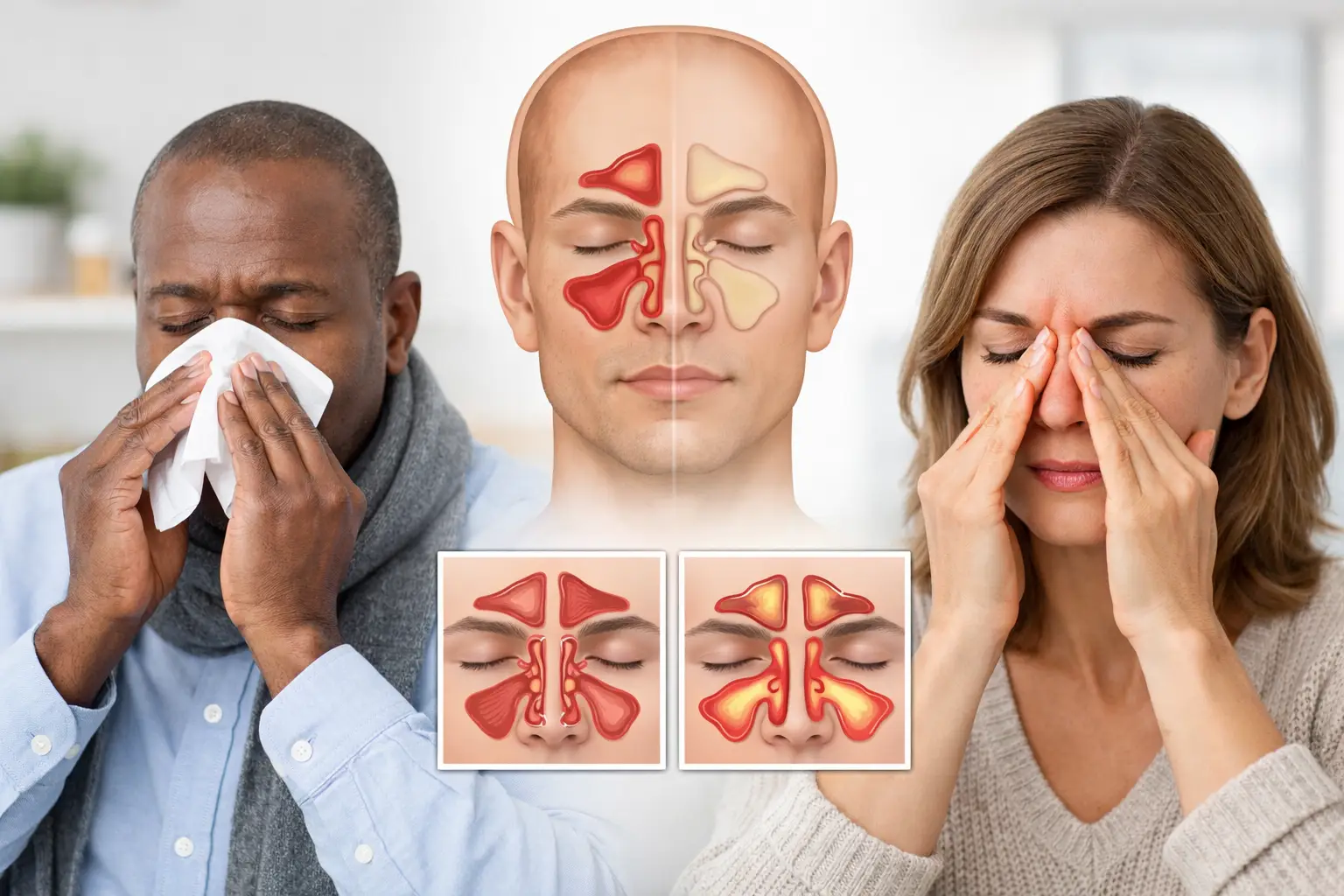
You wake up congested. By midday, your face aches. By evening, you are exhausted. Is this a cold that will pass in a few days — or is it a sinus infection that needs attention?
Rhinosinusitis affects approximately 1 in 8 adults each year, making it one of the most common health complaints worldwide. Yet many people struggle to distinguish sinusitis from a routine cold, delaying the right treatment and prolonging their discomfort.
Sinusitis symptoms are not random. They follow a logical chain: inflammation leads to mucosal swelling, which blocks the narrow drainage channels (ostia) of your sinuses. Trapped mucus creates pressure, and stagnant secretions trigger secondary effects — from facial pain to fatigue to persistent cough.
This guide explains every category of sinusitis symptom — nasal, facial, systemic, and sensory — so you can recognise what your body is telling you and take informed action. You will also learn when sinusitis warrants a visit to your doctor and how a 100% natural medical device like Nasodren® can help relieve symptoms by working with your body’s own clearance mechanisms.
What Are the Main Symptoms of Sinusitis?
Before listing individual symptoms, it helps to understand why they occur. Your paranasal sinuses are air-filled cavities lined with mucous membrane. When an infection, allergy, or irritant triggers inflammation, the following cascade unfolds:
- The mucosal lining swells, narrowing the ostia (tiny drainage openings).
- Mucus production increases but cannot drain normally — a state called mucus stasis.
- Trapped mucus creates negative and then positive pressure within the sinus cavity.
- Stagnant secretions become a breeding ground for bacteria, intensifying inflammation.
The European Position Paper on Rhinosinusitis and Nasal Polyps (EPOS2012) establishes clear diagnostic criteria: a clinician can suspect rhinosinusitis when a patient presents with nasal blockage (or nasal discharge, or reduced/lost sense of smell) accompanied by facial pain or pressure. These cardinal features must be present simultaneously for a reliable diagnosis.
| EPOS2012 Diagnostic Criteria: Nasal blockage PLUS at least one of — facial pain/pressure, nasal discharge, or reduced/lost sense of smell. |
The Centres for Disease Control and Prevention (CDC) identify seven cardinal signs of sinusitis: runny nose, nasal congestion, facial pain or pressure, headache, post-nasal drip, cough, and bad breath. These signs can be grouped into four symptom categories:
- Nasal symptoms — congestion, discharge, post-nasal drip, loss of smell
- Facial symptoms — pain, pressure, and headache localised to sinus regions
- Systemic symptoms — fatigue, fever, cough, bad breath
- Sensory symptoms — reduced smell, altered taste, ear fullness
Understanding which category your symptoms fall into helps you — and your clinician — determine both the type and severity of your sinusitis.
Nasal Symptoms of Sinusitis
Nasal symptoms are the most characteristic features of sinusitis and the ones patients notice first. There are four principal nasal symptoms, each with a distinct mechanism.
Nasal Congestion and Blockage
Nasal congestion is the cardinal symptom of sinusitis and affects the vast majority of patients. It results from swelling of the turbinates — bony structures inside the nose covered by mucous membrane. During a sinus infection, inflammatory mediators cause the turbinates to engorge with blood, physically narrowing the nasal passage. Many patients notice that congestion alternates between nostrils, following the natural nasal cycle, but in sinusitis both sides are typically affected, with one side often worse than the other.
Nasal Discharge
Thick, yellow or green nasal discharge is a hallmark of sinusitis. The colour comes from white blood cells (neutrophils) fighting infection — it does not, on its own, distinguish viral from bacterial sinusitis. Discharge may drain anteriorly (visible when you blow your nose) or posteriorly down the throat, where it is called post-nasal drip.
Post-Nasal Drip
When excess mucus pools in the back of the throat, it produces a characteristic sensation of something running down the back of your throat. Post-nasal drip is particularly noticeable at night and in the morning, when lying flat allows mucus to accumulate. It is one of the primary triggers for the cough associated with sinusitis. Because the trigeminal nerve innervates both the nasal passages and the throat, a product like Nasodren® — which stimulates trigeminal nerve reflexes — can help clear post-nasal drip by promoting rapid mucus clearance from the entire nasal and sinus region.
Loss of Smell
Reduced or lost sense of smell (hyposmia or anosmia) occurs in sinusitis because swollen mucosa blocks odour molecules from reaching the olfactory epithelium — the specialised sensory tissue high in the nasal cavity. This is known as conductive anosmia: the sensory nerve cells themselves are intact, but the pathway is physically blocked. It is important to differentiate this from the sensorineural anosmia seen in COVID-19, where the virus damages the nerve cells directly. In sinusitis, smell typically returns once inflammation subsides and the nasal passages clear. Users of Nasodren® often report improved sense of smell within the first few days, as the product’s mechanism clears obstructed passages.
Facial Pain and Pressure — The Hallmark Symptom
Facial pain and pressure is the symptom that drives most people to seek treatment. It arises because inflamed, blocked sinuses trap air and mucus, creating both negative pressure (during early blockage) and positive pressure (as secretions accumulate). The pain character is typically dull, deep, and aching — not sharp or stabbing — and it often worsens when you bend forward, because venous pressure in the head increases.
The location of pain often corresponds to which sinus is affected:
- Forehead (frontal sinuses): A tight band of pressure across the brow.
- Cheeks and upper teeth (maxillary sinuses): The most common site. Because the roots of the upper molars sit close to the floor of the maxillary sinus, this pain is frequently mistaken for a dental problem.
- Between the eyes (ethmoid sinuses): Intense discomfort around and behind the eyes.
- Behind the eyes and top of the head (sphenoid sinuses): Deep, diffuse pain that may radiate to the neck. The proximity of the sphenoid sinus to the optic nerve makes symptoms in this region a particular concern.
A critical differentiator: true sinus headache is almost always accompanied by other sinusitis symptoms — congestion, nasal discharge, or reduced smell. If you experience headache without these nasal symptoms, the cause is more likely a migraine. A landmark study of approximately 3,000 patients found that nearly 90% of self-diagnosed “sinus headaches” actually met the clinical criteria for migraine. Thick nasal discharge combined with pain that worsens when bending forward are the most reliable signs that facial pain is genuinely sinus-related.
Systemic Symptoms: When Sinusitis Affects Your Whole Body
Sinusitis is more than a localised nasal problem. The cytokine-driven inflammatory response that occurs during infection can affect your entire body. Five systemic symptoms deserve particular attention.
Fatigue and Malaise
Fatigue is one of the most under-appreciated symptoms of sinusitis. It results from a combination of disrupted sleep (nocturnal congestion makes breathing difficult), the metabolic cost of fighting an active infection, and the systemic effects of inflammatory cytokines. Patients with chronic sinusitis often rate fatigue as more disabling than pain itself.
Cough
The cough of sinusitis has a distinctive pattern: it is typically worse at night and first thing in the morning. It is triggered by post-nasal drip — when you lie flat, mucus pools in the throat and irritates the cough receptors. This is a throat-level cough, not a deep bronchial cough, and it may be dry or productive.
Fever
Low-grade fever (37.5–38.3 °C) is common in acute sinusitis, reflecting the body’s immune response. High fever above 39 °C warrants prompt medical evaluation, as it may indicate a more serious bacterial infection or complication.
Bad Breath (Halitosis)
Stagnant, bacteria-laden mucus in the sinuses and post-nasal drip coating the tongue produce a characteristic unpleasant odour. Halitosis that persists alongside nasal congestion is a strong indicator of underlying sinusitis.
Ear Pressure and Fullness
The sinuses and middle ear share drainage territory via the Eustachian tube. When sinus inflammation extends to this structure, patients experience a sensation of ear fullness — often described as an “underwater” feeling. This can also cause mild hearing changes and, in children, contribute to ear infections.
How Sinusitis Symptoms Differ by Type
Not all sinusitis is the same. The EPOS2012 classification divides rhinosinusitis into distinct types, each with a characteristic symptom profile. Recognising which pattern matches your experience is key to understanding your condition.
Acute Sinusitis (Less Than 4 Weeks)
Acute sinusitis typically begins 5 to 7 days after the onset of a common cold. Symptoms are sudden and severe: intense nasal congestion, thick discharge, pronounced facial pain, and often fever. More than 90% of acute sinusitis cases are viral and self-limiting, resolving within 10 days. The critical red flag: if symptoms worsen after initial improvement (the “double-sickening” pattern), bacterial sinusitis should be suspected.
Subacute Sinusitis (4 to 12 Weeks)
Subacute sinusitis is a transitional phase. Symptoms persist beyond the expected timeframe of a cold but have not yet reached the 12-week chronicity threshold. Patients describe lingering stuffiness, intermittent facial discomfort, and a fatigue that simply will not lift. This phase often develops when acute sinusitis was incompletely treated.
Chronic Sinusitis (12 Weeks or Longer)
Chronic sinusitis represents a shift in the symptom profile. Severe acute pain gives way to persistent, low-grade obstruction, ongoing post-nasal drip, fatigue, and progressive loss of smell. Patients describe the experience as “wearing” rather than “hurting.” EPOS2012 requires at least two cardinal symptoms for 12 weeks or more, together with objective evidence of inflammation on nasal endoscopy or CT scan, for a chronic rhinosinusitis diagnosis.
Recurrent Acute Rhinosinusitis
Some individuals experience four or more distinct acute episodes per year, with symptom-free intervals between them. Each episode resembles full acute sinusitis. An underlying cause — such as anatomical abnormality, allergy, or immune deficiency — should be investigated.
Sinusitis Symptoms in Special Populations
Sinusitis does not present identically in everyone. Three groups require particular awareness.
Children
Paediatric sinusitis often presents as “a cold that will not go away.” Young children cannot articulate facial pressure, so behavioural changes are the clue: persistent nasal discharge (any colour), mouth breathing, snoring, daytime fatigue from poor sleep, irritability, and reduced appetite. Cough — wet and lasting more than 10 days — is more prominent in children than in adults.
Older Adults
In elderly patients, the inflammatory response is often blunted by age-related immune changes. Symptoms may be subtler: vague discomfort rather than frank pain, pronounced fatigue, and sometimes confusion — a non-specific sign of infection in older adults. Fever and purulent discharge may be absent even in significant infection. A higher index of clinical suspicion is needed.
Pregnancy
Pregnancy rhinitis — hormonal nasal congestion affecting up to 30% of pregnant women — can mimic sinusitis. True sinusitis during pregnancy presents with the usual symptoms but treatment options are limited. Saline irrigation and steam inhalation are first-line approaches. Because Nasodren® is a Class IIA medical device (CE 0051) whose active saponins are not absorbed into the bloodstream, it may be a suitable option; however, pregnant or breastfeeding women should always consult their obstetrician before use, as no clinical studies have specifically included this population.
When to See a Doctor for Sinusitis Symptoms
Most cases of acute sinusitis resolve on their own. However, certain patterns and warning signs should prompt professional evaluation. Use the following framework to guide your decision.
See Your Doctor If:
- Symptoms last more than 10 days without improvement.
- Symptoms worsen after initial improvement (the “double-sickening” pattern).
- Fever above 38 °C persists for more than 3 to 4 days.
- You experience three or more sinus infections per year.
- Over-the-counter treatments provide no relief.
Seek Urgent or Emergency Care If:
- Swelling, redness, or pain around the eyes.
- Vision changes — double vision, blurred vision, or vision loss.
- Confusion, drowsiness, or altered mental state.
- Severe headache unresponsive to standard pain relief.
- Stiff neck combined with light sensitivity.
- Fever above 39.5 °C.
These red flags may signal orbital or intracranial complications — rare but serious emergencies that require immediate treatment. When in doubt, see a doctor.
How Nasodren® Helps Relieve Sinusitis Symptoms
Once you understand the mechanism behind sinusitis symptoms — inflammation, blockage, pressure build-up, and mucus stasis — the logical treatment goal becomes clear: restore drainage. This is precisely what Nasodren® is designed to do.
Nasodren®, developed by Hartington Pharmaceutical SLU in Barcelona, is a 100% natural nasal spray made from the lyophilised extract of fresh Cyclamen europaeum tubers. It is classified as a Class IIA medical device (CE 0051), not a pharmaceutical product, and it works through a unique physical mechanism rather than pharmacological action.
Here is how it works:
- Saponins from the Cyclamen extract stimulate sensory receptors of the trigeminal nerve in the nasal cavity.
- This triggers a rapid reflex that stimulates mucociliary clearance throughout the sinuses.
- Mucus that was trapped behind blocked ostia begins to drain — often within minutes of the first application.
- As drainage is restored, congestion, facial pressure, and post-nasal drip begin to resolve simultaneously.
Clinical evidence supports this approach. In clinical studies referenced in the EPOS2012 guidelines — where Nasodren® received a Level of Evidence Ib and Grade of Recommendation A, the highest level awarded to any natural product — around 94% of patients experienced significant or complete improvement in their symptoms. Clinical studies report that 90% of patients restore normal sinus function within 7 days.
Over 30 published clinical studies, published in journals including Rhinology and The Laryngoscope, confirm the efficacy and safety profile of Nasodren®. It is preservative-free, contains no steroids or antibiotics, carries no risk of rebound congestion, and has no habit-forming properties.
Nasodren® is used once daily — one spray per nostril — and each bottle provides 30+ applications. It is priced at €29.50 and is compatible with other treatments, as its physical mechanism does not create pharmacological interactions.
EPOS guidelines include Cyclamen europaeum extract with a Level A recommendation, though Cochrane systematic reviews note that further evidence is needed to confirm efficacy. Nasodren® is indicated to relieve symptoms of rhinosinusitis and to help restore normal sinus function.
| Nasodren® — 100% natural, CE 0051 Class IIA medical device, once daily, 94% symptom improvement, €29.50. Breathe the difference. |
For patients who have been told there is “nothing more we can do” for their chronic sinusitis, or for those seeking a natural, evidence-based option alongside conventional care, Nasodren® offers a physiologically intelligent approach to symptom relief.
Frequently Asked Questions About Sinusitis Symptoms
Q: What are the first signs of a sinus infection?
The earliest signs typically appear 5 to 7 days into a cold that is not improving. Nasal congestion worsens rather than resolving, discharge becomes thicker and may turn yellow or green, and a dull facial pressure develops — particularly around the cheeks and forehead. If your cold symptoms intensify after initially improving, this “double-sickening” pattern is a strong indicator of sinusitis.
Q: How do I know if I have sinusitis or just a cold?
The key differentiators are duration and pattern. A common cold peaks around days 2 to 3 and resolves within 7 to 10 days. Sinusitis symptoms persist beyond 10 days or follow the double-sickening pattern. Facial pain that worsens when bending forward, and thick nasal discharge, are more specific to sinusitis than a cold.
Q: Can sinusitis cause body aches and fatigue?
Yes. The systemic inflammatory response triggered by sinusitis — driven by cytokines — can cause fatigue, general malaise, and body aches. This is more pronounced in bacterial sinusitis and chronic cases, where ongoing inflammation drains your energy reserves and disrupts sleep.
Q: What does sinus pressure feel like?
Sinus pressure is typically a dull, throbbing ache localised to the cheeks, forehead, or the area between the eyes. It often worsens when you bend forward, strain, or lie flat. Some patients describe a sensation of fullness or heaviness in the face rather than sharp pain.
Q: Is loss of smell a sinusitis symptom?
Yes — and it is one of the cardinal diagnostic criteria in EPOS2012. In sinusitis, smell loss is conductive: swollen mucosa physically blocks odour molecules from reaching the olfactory receptors. This differs from the sensorineural damage seen in COVID-19. When inflammation clears, smell typically returns.
Q: Can Nasodren® help with my specific symptoms?
Nasodren® addresses the root mechanism of sinusitis symptoms — blocked sinus drainage. By stimulating the trigeminal nerve to promote rapid mucociliary clearance, it helps relieve congestion, facial pressure, and post-nasal drip simultaneously. Clinical studies report around 94% significant or complete symptom improvement. As a physical (not pharmacological) treatment, it works alongside other therapies without interaction concerns.
Key Takeaways: Recognising and Responding to Sinusitis Symptoms
Understanding your symptoms is the first step towards effective relief. Here are the essential points from this guide:
- Sinusitis symptoms fall into four categories — nasal, facial, systemic, and sensory — each reflecting the underlying inflammatory cascade.
- The EPOS2012 diagnostic triad requires: nasal blockage plus at least one of facial pain/pressure, nasal discharge, or reduced sense of smell.
- Symptoms lasting more than 10 days or following a double-sickening pattern suggest bacterial sinusitis — see your doctor.
- Red flags — eye swelling, vision changes, confusion, stiff neck — are medical emergencies.
- Symptom profiles differ by sinusitis type. Chronic sinusitis is “wearing” rather than “hurting,” with fatigue and smell loss often more prominent than acute pain.
- Nasodren® provides rapid, natural symptom relief by activating the body’s own clearance mechanism — 100% natural, CE 0051 Class IIA medical device, once daily, 94% efficacy, €29.50.
| If you recognise your symptoms in this guide and are ready for relief that works with your body rather than against it, discover Nasodren® at nasodren.com. |
Related Articles